


How to Dispute Errors in your Credit Report?

Loading your search...
Credit bureaus in the country collect individual data and prepare a credit report. They also calculate the credit score using their proprietary algorithm. However, there could be errors in your credit report that can hamper your chances of getting loan approval.
What is a Credit Report Dispute?
A credit report dispute is the action of notifying a credit bureau such as CIBIL, Experian, CRIF High Mark, Equifax, or TransUnion - to investigate something on the credit report that you believe is inaccurate or incomplete.
Monitoring your credit report should be done regularly because it will allow you to identify these types of mistakes early, including inaccurate personal information, multiple entries, misreported payments, or a past due account that should be reported as inactive. Identifying inaccuracies early on will help you prevent the errors from affecting your credit score or ability to obtain loans.
Why Monitoring your Credit Score is important?
Monitoring your credit score will also help you identify if someone has opened accounts in your name as a sign of potential fraud or identity theft. Once you have identified an error you believe you did not create, the credit dispute process will begin. You will need to obtain documentation to substantiate your claim, then submit the claim to the credit provider.
In certain conditions, the lender or bank who supplied the inaccurate or incomplete information (the data furnishers), may need to be contacted as well. Credit bureaus will conduct their investigation and may complete any corrections in 30-45 days. Reducing errors in your credit report through active monitoring and disputes will help you maintain and improve your overall credit profile, protect your credit score and assist in your chances of securing loans and credit.
How to Raise a Credit Report Dispute: A Simple Step-by-Step Process
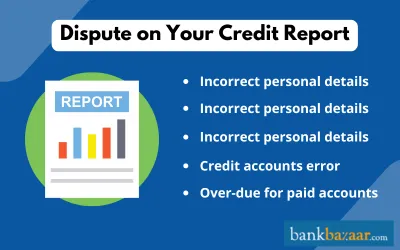
A credit report dispute is necessary when there are errors that could hurt your credit or CIBIL report. A dispute will provide a means for inaccurate or incomplete information to be researched and corrected. Here is a step-by-step guide:
- Get your Credit Report: The first step after you have decided to file a dispute is to download your credit report from all major bureaus, CIBIL, Experian, Equifax, CRIF High Mark, and Trans Union. Monitoring all reports will illuminate any inconsistencies or errors that may or may not be reported in one bureau, but not in the others.
- Identify the error: Once you have your credit reports, you need to review your personal information, account details, payment history, public records, and any credit inquiries. If there are errors in the reports, you will need to make a note of the error and then take special note of the specifics of the information that needs to be corrected (i.e. incorrect balance, misreported late payments, duplicate accounts, etc.).
- Prepare Documentation: You will need to prepare evidence and documentation to prove your claim. This may include bank statements, payment receipts, loan agreements, settlement letters, utility bills, identification, etc. This type of accurate documentation will add to the dispute, which speeds up the process.
- File a Dispute: You can file a dispute on the authority's on-line portal, by mail, or on-line with their customer service desk, (listed or the request displayed on a website). You will need to fill in the contents of the dispute: the discrepancy, incorrect information or evidence, and any supporting documentation. You will also want to include the control number or reference ID (on the governing report), which identifies your claim to that control number or identifier.
- Reach Out to the Data Provider: In some instances, it may be necessary to reach out to the lender or institution that reported the inaccurate information (the data provider). You may be able to help expedite the correction by providing them with supporting documentation.
- Wait for the Investigation: Credit bureaus typically investigate disputes within 30 - 45 days. They will contact the data provider to verify the information, and if your dispute is valid, they will update your report accordingly.
- Review the Updated Report: After the investigation is complete, review your credit report to confirm that everything is correct. You can also request a statement of the investigation's result for your records, if necessary.
Documentation Needed for Filing a Credit Report Dispute
Filing a dispute on a credit report requires precise, clear, and perfectly organized documents. The evidence you submit assists the credit reporting agency and the lender (data furnisher) in confirming your information and promptly updating the records. Having the documents you need can greatly speed up the dispute and improve the success rate of any outcome.
The following documents may be needed:
Document Type / Purpose | Examples / Importance |
Personal Identification Documents – Used to verify your identity and ensure the dispute applies to the correct credit report | Passport, driver’s licence, PAN card, Aadhaar card, utility bills showing your name and current address. Prevents misidentification and ensures corrections are applied to the right report. |
Account Statements and Records – Demonstrate repayment history and validate account details | Bank statements, credit card statements, EMI receipts, loan agreements, settlement letters. Provides evidence of payment discrepancies, balance errors, or incorrect account closure reporting. |
Settlement or No Dues Certificates – Prove that loans have been settled or written-off accounts are cleared | Official letters from lender confirming account closure or settlement. Strong evidence to update account status with the credit bureau and correct negative remarks. |
Court or Legal Documents – Validate legal actions or public records impacting credit | Bankruptcy filings, court orders, tax liens, judgment copies. Ensures legal errors or outdated legal information is corrected on the report. |
Correspondence with Lenders – Document communication regarding corrections, payments, or disputes | Emails, letters, notices from lenders regarding corrections or account status. Strengthens your dispute by showing prior attempts to correct information directly with the lender. |
Dispute Form or Letter – Official submission to the credit bureau describing the error and providing evidence | Completed online or paper dispute form with report/control number, detailed explanation, and attached supporting documents. Ensures the bureau understands the dispute and can process corrections accurately. |
Important Information in a Credit Report
A credit report is an extensive record of your financial history and will indicate how you have behaved when borrowing and repaying debt. Knowing what information is contained in your report is important so that you can spot errors and challenging information.
Credit reporting agencies, such as CIBIL, Experian, Equifax, CRIF High Mark, and TransUnion, compile this report based on data sources from banks, lenders, and financial institutions. The credit report has the following information:
- Personal Information: Your report will contain your name, date of birth, current address and prior addresses, other identifiers such as PAN or Aadhaar number, as well as your work history. Errors in the name(s) or prior addresses could lead to future reporting errors that could impact your creditworthiness.
- Account Information: Lists all of your credit accounts, including credit cards, personal loans, home loans, vehicle loans, and any other borrowings. This includes account numbers, dates of opening and closing, credit limits, current outstanding balances, and your payment history. If there are errors in this section, such incorrect outstanding balances and accounts listed as delinquent, it can significantly lower your overall credit or CIBIL score.
- Public Information and Collections: Your report will also include information about bankruptcies, lax liens, and accounts sent to collections. Errors in this section must be reported accurately because lenders will heavily weigh public information and collections when considering risk for lending purposes.
- Credit checks: Whenever a lender or creditor examines your credit, it counts as an inquiry. Having numerous hard inquiries in a short time will decrease your score.
Types of Errors that are Common on Credit Reports
Here is a table summarizing the different types of errors that appear often in the credit report and their impact on the credit score:
Section / Error Type | Description | Examples | Impact on Credit Score |
Personal Information | Details that identify | Name, date of birth, PAN, Aadhaar card/previous addresses, employment info | Errors can cause misidentification, delays in loan approvals, or association with incorrect accounts |
Personal Information Errors | Mistakes in your identifying details | Misspelled name, wrong DOB, outdated address, incorrect employment | Can reduce creditworthiness, prevent loan approval, or trigger misreported accounts |
Account Information | Details of your credit accounts | Credit cards, personal/home/vehicle loans; account numbers, opening/closing dates, balances, credit limits | Inaccuracies can misrepresent repayment behaviour, lower credit score, or affect eligibility for new credit |
Account Information Errors | Incorrect reporting of credit accounts | Wrong balance, late payments marked incorrectly, closed accounts listed as open, duplicate accounts | Can lower score, create false defaults, mislead lenders about your financial reliability. |
Delinquency / Payment History | Shows if you’ve paid on time | Days Past Due (DPD), missed EMIs, late payments | Misreporting can falsely indicate poor repayment habits, reducing creditworthiness |
Delinquency Reporting Errors | Incorrect overdue reporting | DPD errors, payments reported late even if on time | Creates false defaults, reduces score, affects eligibility for loans and credit cards |
Public Records & Collections | Bankruptcies, liens, accounts sent to collections | Bankruptcy filings, tax liens, unpaid collections | Significant impact on score, may restrict loan approvals or increase interest rates |
Public Records & Collection Errors | Errors in these records | Wrong bankruptcy dates, incorrect lien amounts, collection accounts not updated | Can drastically lower credit score and misrepresent repayment behaviour |
Credit Inquiries | Records of who accessed your credit | Lenders, banks, financial institutions checking your report | Multiple hard inquiries may reduce score slightly, soft inquiries do not |
Inquiry Errors | Mistakes in reporting inquiries | Unauthorised hard inquiries, duplicate inquiries | May signal higher credit risk, slightly reducing score |
Closed Account Reporting Errors | Accounts marked incorrectly as open or active | Paid-off loans still showing active, credit cards incorrectly listed | Affects credit utilisation ratio and score |
Identity Theft / Fraud-Related Errors | Accounts opened fraudulently in your name | Unknown credit cards, loans, or lines of credit appearing on your report | Can drastically lower score and misrepresent creditworthiness |
Data Duplication Errors | Same account reported multiple time | One loan appearing twice or more | Inflates debt levels, lowers credit score |
Paid-Off Account Errors | Fully repaid accounts still showing balance | Loans or credit cards marked overdue after settlement | Misleads lenders, reduces credit score unnecessarily |
Documentation / Supporting Errors | Errors in reporting supporting documents | Incorrect court filings, misreported loan settlements | Can affect dispute resolution and ongoing reporting accuracy |
How to Submit a Credit Report Dispute (CIBIL Report Errors and How to Resolve Them)
The timeline for the dispute process is as follows:
- Step 1: Filing the Dispute (Day 0)
The moment you submit your dispute to the credit bureau along with supporting documents, the bureau receives your dispute complaint and a reference number. Generally, you will receive confirmation by e-mail or postal mail. This serves as your proof that you filed your complaint.
- Step 2: Initial Review (Days 1 to 5)
The bureau conducts an initial review to determine if you filed a complete dispute. If any documents are missing, or if the dispute is vague, the bureau may reach out to you for clarification. If you provided accurate, complete, and thoughtful documentation, this would expedite your dispute process and prevent confusion of delays.
- Step 3: Verification with the Data Furnisher (Days 6 to 30)
The credit bureau provides verification of the accuracy of the disputed information to the lender or data furnisher. The data furnisher reviews their records, confirms or denies the claim, and reports back to the credit bureau.
- Step 4: Investigation by the Bureau (Days 31 to 45)
The bureau investigates and thoroughly checks the account statements, historical records, and any legal documents sent in by the data furnisher depending on what they said. They will determine whether the disputed item should be updated or removed.
- Step 5: Notification Regarding Outcome (Within 45 Days)
Once the bureau has finished their investigation, they will send you notice about its outcome. If your dispute is validated, the bureau will change, update, or delete the disputed item from your credit report, and you will receive this acknowledgment by mail or email.
- Step 6: Updated Credit Report (After Resolution)
After a dispute is resolved and the bureau has changed it, the bureau will issue an update to your credit report. It is a good idea to request a new copy in case there are any changes to confirm your score still reflects your financial behavior.
- Step 7: Respond (If needed)
If a dispute is not resolved as desired or is denied incorrectly, you can escalate to the credit bureau, the original credit source or lender, or consumer affairs type agency. Save all documents and notes for any future discussions.
Here's a comprehensive table outlining the official procedures to raise a credit report dispute with each of the four major credit bureaus in India:
Credit Bureau | Official Website | Dispute Process |
CIBIL (TransUnion CIBIL) | Online Dispute Form: Submit a completed form on the official website. myCIBIL Portal: Log in to myCIBIL, navigate to 'Credit Reports', select 'Dispute Centre', and click on 'Dispute an Item'. Postal Mail: Send a written dispute to: TransUnion CIBIL Limited, One Indiabulls Centre, Tower 2A, 19th Floor, Senapati Bapat Marg, Elphinstone Road, Mumbai - 400 013. | |
Equifax India | Online Dispute: Enter your credit report number on the official website to register a dispute. Email Support: Send an email to ecissupport@equifax.com. Phone Support: Call 1800 209 3247 for assistance. | |
Experian India | https://consumer.experian.in/ECSINDIA-DCE/view/angular/index.html | Online Dispute: Enter your Experian Reference Number and Unique Transaction ID on the official dispute portal. |
CRIF High Mark | Online Portal: Log in to the portal, go to 'My Report', select 'Raise a Query', choose the credit report, and click 'Proceed'. Email Support: Send an email to crifcare@crifhighmark.com. |
Note: It's advisable to retain copies of all correspondence and documents submitted during the dispute process for future reference.
Tips for Quick Resolution of Your Dispute
Follow the suggestions below to resolve your credit report dispute easily:
- Provide All Necessary Documentation: Assemble all relevant documents before submitting a dispute, including bank statements, loan documents, EMI receipts, settlement letters, ID proof and documentation pertaining to previous communications with lenders. Having full documentation reduces the potential back-and-forth between you and the dispute process and allows for more rapid verification.
- Clearly Identify the Error: Make it clear what the dispute is regarding and specify the exact error that exists on your credit report, which may involve inflated balances, incorrect account statuses like ‘accounts in good standing’, having duplicate accounts, being reported as late on payments, or being reported as having unauthorized inquiries. Present a Clearly Written Short Statement: It is a good idea to develop your own statement based on your disputes described in a concise manner in the dispute form or letter. Write down all the details of the dispute specifically.
- Use the Credit Bureau’s Designated Channels: You utilize certified mail, or the bureau’s online portal as these channels allow you to receive something in writing regarding the dispute(who did you sent this to and verify their authorized personnel).
- Include the Reference Number: Always provide the control number or reference number from your Credit report. Making sure that the appropriate dispute is headlined in the correct report will expedite the dispute.
- Regularly follow-up Frequently: Be organized and MV (most valuable person person) when inquiring about the status of the dispute regularly. Be sure to respond to the CUB, if it requests additional proof of the dispute at any point--try not to lose time reporting--response immediately.
- Keep Documentation: Retain copies of every form, document, or piece of correspondence you send. This could help you assert your claim in the event that you have to escalate or follow up on your submission.
- Contact the Data Furnisher: If you need to investigate your claim further you should communicate directly with the lender or creditor that is reporting the inaccuracy - if they are responsive, that could lead to quicker resolution. You would send them the same documentation for confirmation.
- Don't Submit Multiple Disputes for the Same Issue: When disputing the accuracy of your credit file, don't submit multiple dispute forms for the same issue, or for related claims, unless you are clear in the disputing documentation regarding how the claims are related. Doing so could confuse the resolution process and slow the provider down.
Note: Be alert when you have a new credit report. After the dispute is resolved, download your credit report and verify that your dispute is correctly resolved and your score is corrected (if necessary).
- How to improve your CIBIL Credit Score
- Major Factors That Affect Your CIBIL Score
- Missing a Single Payment Can Affect Your CIBIL Score
- Top CIBIL score improvement factors
- Impact of Late Payment on CIBIL Score
- How to Increase Cibil Score
- How Can Credit Score Affect Your Daily Life
Know More About CIBIL
TransUnion CIBIL is one of the leading credit information companies in India. The company maintains one of the largest collections of consumer credit information in the world. CIBIL Score plays a key role in the lives of consumers. Banks and other lenders check the CIBIL Score of the applicants before approving their loan or credit card application. Consumers can visit the official website of CIBIL to check their CIBIL Score and Report. CHECK YOUR CIBIL SCORE now.
FAQs
- How long does a credit report dispute take?
Disputes in India generally take 30 to 45 days to resolve. The time taken depends on the complexity of the inaccuracy, as well as the credit lender or data furnisher's responsiveness.
- How can I check my credit report for errors?
CIBIL, Equifax, Experian, and CRIF High Mark provide one free credit report per annum. Read through the personal identification details, account details, payment history, and inquiries thoroughly. If you identify inaccuracies early, you can dispute them before they affect your credit score or your loan application.
- Can I dispute multiple errors at one time?
Yes, you can dispute multiple errors in a single dispute submission. Make sure to separate each error out clearly and provide documents with each violation.
- Does disputing an error have an effect on my credit score?
No. Reporting a dispute does not affect your credit score. Your score may go up if the negative information is deleted once they correct an inaccuracy. Disputing an error is a harmless way to report accurately on your credit report.
- Can I dispute errors on joint accounts?
Either account holder can report incorrect information on a joint account. Both account holders should report the error and provide supporting documentation to validate the dispute.
- What documentation do I need to dispute an error?
You will need verifiable identification (e.g., PAN, Aadhaar, passport), statements from the account, loan agreements, letters of settlement, or court documents.
- Can mistakes arising from identity theft be disputed?
Yes. You will want to include supporting documents with your dispute like police reports, affidavits, or fraud complaints.
- Are soft inquiries disputable?
Soft inquiries, like pre-approved offers for credit, do not count against your score and disputed. Only incorrect hard inquiries, which can affect your credit score, should be disputed.
- Can errors on a credit report older than several years be disputed?
Yes. Even if the mistake has existed for several years, your right to dispute it is intact. Older negative items tend to require more evidence, but the bureaus are obligated to investigate and remove any errors that can be verified, no matter how old the error may be.
- Do you need a lawyer to dispute?
No. Anyone can file a dispute with the bureaus as long as the documentation is proper and the paperwork is self-explanatory. An individual will need a lawyer if the credit dispute escalates and the lawyer will provide some assistance if you are a victim of identity theft.
CIBIL Score Requirements for Loans

Disclaimer
Credit Card:
Credit Score:
Personal Loan:
Home Loan:
Fixed Deposit:


Copyright © 2026 BankBazaar.com.